
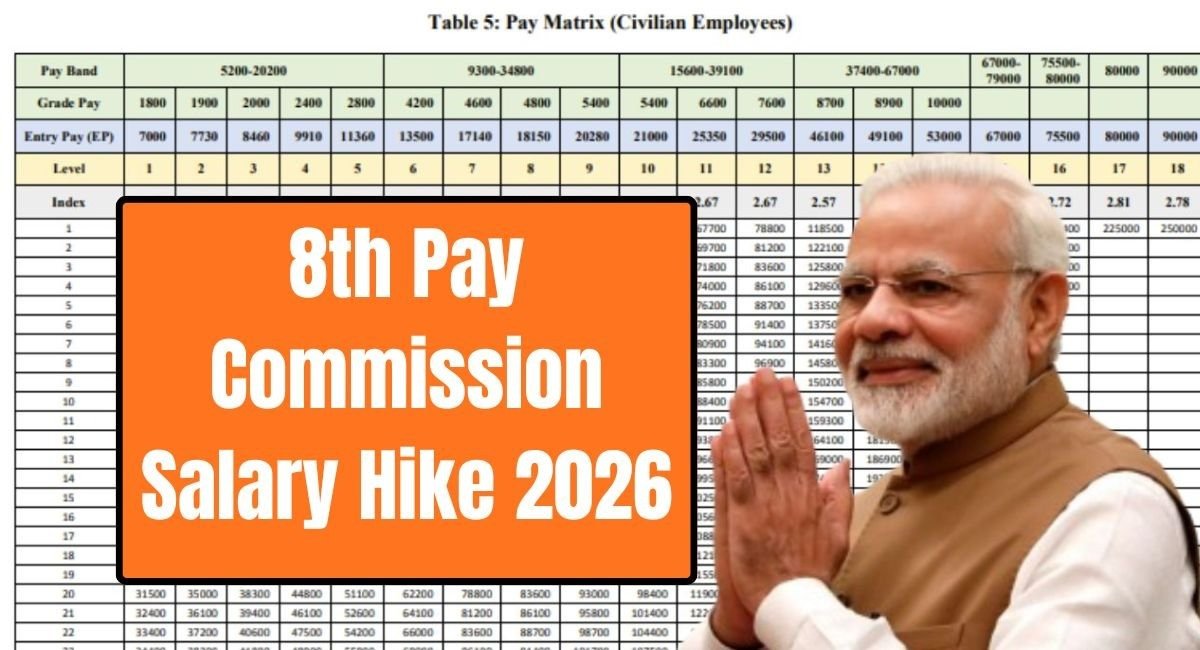
The 8th Pay Commission is set to bring a major financial boost for more than one crore central government employees and pensioners in India. Taking effect from January 1, 2026, the new pay structure is expected to deliver an average salary and pension hike of 30–35 percent. With the fitment factor likely finalized at 2.46, government staff can look forward to significantly higher pay, arrears, and improved allowances, reshaping their monthly income and savings potential in the process.
8th Pay Commission Update 2025: Framework and Timeline
The Union Cabinet officially approved the constitution of the 8th Central Pay Commission in January 2025, with the Terms of Reference (ToR) gazetted on November 3, 2025. Justice Ranjana Prakash Desai heads the panel, which will complete its report within 18 months. The recommendations are expected to be implemented on January 1, 2026, replacing the 7th CPC structure that has been in effect since 2016.
This new commission follows the tradition of periodic pay reviews every 10 years to ensure employee compensation keeps pace with inflation, productivity, and the rising cost of living.
Fitment Factor 2.46: The Core of the Pay Matrix
The fitment factor is central to every Pay Commission’s implementation. It determines how existing basic pay translates into the new scale. For the 8th Pay Commission, a mid-point estimate of 2.46 has been proposed—an increase that aligns with the government’s inflation adjustment and revenue capacities.
This fitment factor merges the existing 58 percent Dearness Allowance (DA) into the basic pay, resetting DA to zero from January 2026. The revised matrix will reflect consolidated pay scales with higher starting points across all grade levels, ensuring fairness in progression for employees of varying seniority.
Step-by-Step Salary Calculation: Fitment Formula Explained
To calculate the new basic pay under the 8th Pay Commission, the following formula applies:
Formula:
New Basic Pay = (Current Basic × 1.58 DA Merger) × 2.46
Here, “1.58” represents the total salary after adding 58 percent of the existing DA, while “2.46” multiplies that figure to align with the proposed fitment factor. Once calculated, the new amount is matched with the nearest cell in the revised pay matrix.
Examples (approximate projections for January 2026):
- Level 1 employee: ₹18,000 × 1.58 = ₹28,440 × 2.46 = ₹69,962 (rounded to ₹70,000)
- Level 5 employee: ₹29,200 × 1.58 = ₹46,136 × 2.46 = ₹113,494
- Level 10 employee: ₹56,100 × 1.58 = ₹88,638 × 2.46 = ₹218,049
These represent sizable jumps across levels, boosting overall monthly earnings between ₹50,000 and ₹1.2 lakh depending on rank, allowances, and location category.
Key Financial Enhancements Expected in 2026
1. Minimum Basic Pay:
Set to increase from ₹18,000 (7th CPC) to around ₹70,000 under the new matrix, the hike marks the largest base-level revision in decades.
2. Dearness Allowance (DA):
The existing 58 percent DA will merge with the basic pay, resetting to zero. DA will then be recalculated on the revised scale starting July 2026, ensuring allowance growth continues in sync with inflation.
3. House Rent Allowance (HRA):
HRA under the 8th Pay Commission is projected between 27 and 30 percent of the new basic pay, varying by city classification (X, Y, Z).
4. Pension Revision:
Pensioners will receive 50 percent of the newly calculated basic pay, leading to a parallel hike of 30–34 percent in pension amounts. The minimum pension may rise to ₹35,000 per month, ensuring financial stability for retirees.
5. Arrears Payment:
Implementation delays are expected to result in arrears of up to 17 months, payable in a lump sum through direct benefit transfer (DBT). While no interest will apply, the payout will have a significant positive impact on household liquidity.
Eligibility and Automatic Inclusion
The 8th Pay Commission benefits automatically cover:
- All central government employees under the 7th CPC framework (civilian and defence)
- Pensioners, family pensioners, and retirees before 2026 (with full pay parity)
- Employees under NPS and UPS systems in eligible departments
The scheme will exclude casual or contractual workers. State governments can autonomously decide to adopt these recommendations, following budget reassessment. Verification of beneficiaries will occur automatically through Aadhaar-linked payroll systems for smoother rollout.
Comprehensive Benefits and Economic Impact
The 2026 salary increment is expected to add around ₹2 lakh crore into the Indian economy, creating an estimated 1 percent rise in GDP. Government spending will inject liquidity into housing, retail, education, and mutual fund sectors as employees and pensioners receive lump-sum arrear payments.
Key gains for employees:
- Take-home salary increase of around 35 percent
- Monthly entry-level boost of approximately ₹30,000 or more
- Arrears payout in the range of ₹2–6 lakh per employee
- Better savings and loan repayment potential
For pensioners and retirees:
- Pension amounts to rise by up to 34 percent
- Minimum pensions revised to ₹35,000 per month
- Protection against inflation ensured through future DA hikes
For investors:
With extra liquidity, employees are expected to boost investments in fixed deposits yielding 7.5 percent or in mutual funds offering up to 12 percent annual returns—potentially generating additional income of nearly ₹60,000 a year for many.
Tax and Allowance Adjustments
The salary hike will bring corresponding adjustments in income tax slabs and 80C deductions to ensure net take-home pay is not adversely affected. Employees should plan to optimize their savings with increased contributions to NPS, EPF, or short-term investment instruments for maximum tax efficiency.
Broader Effects on Inflation and Consumption
While there may be a short-term rise in consumption-led inflation, economic analysts expect this to balance out as spending boosts demand in domestic sectors. The 8th Pay Commission’s rollout mirrors the economic stimulus effect seen in previous pay revisions, driving higher output and growth in several consumer-driven segments.
Final Thoughts
The 8th Pay Commission Salary Hike 2026, anchored by a projected fitment factor of 2.46, signals a new era of financial empowerment for India’s public workforce. It effectively merges 58 percent DA into the basic pay, resets allowances, and raises both employee and pensioner incomes to modern standards.
As the implementation date of January 1, 2026, approaches, this reform represents not just a salary revision but a nationwide impetus for financial stability and economic expansion. Central employees can look forward to stronger paychecks, higher savings, and greater financial dignity in the years to come.